Tel / WhatsApp: +852-70974333 E-mail: andy@pursueartlife.com

- All
- Product Name
- Product Keyword
- Product Model
- Product Summary
- Product Description
- Multi Field Search
Please Choose Your Language
Views: 0 Author: Site Editor Publish Time: 2026-06-25 Origin: Site
Selecting wall art represents a critical operational decision. It goes far beyond simple aesthetic preferences. This choice acts as a high-stakes commercial procurement challenge. Your decisions directly impact brand perception. They also dictate future maintenance overhead. They govern strict code compliance. Hospitality design faces harsh operational realities. Artwork must endure intense daily environments. Guests subject spaces to heavy, constant traffic. Housekeeping teams apply rigorous cleaning protocols. Canvases face variable humidity levels. Sunlight causes significant UV exposure. Throughout all this, properties demand strict visual consistency. Hundreds of rooms must look identical. You cannot afford fading or warping. We introduce a structured evaluation framework below. You will learn how to source reliable materials. We will show you how to specify requirements accurately. You will discover methods for scaling canvas art across massive hospitality projects successfully.
Procuring art for hospitality spaces demands strict quality control. Residential canvas pieces look great initially. However, they fail rapidly under heavy commercial use. We call this the durability gap. Hotel corridors experience high foot traffic. Guest rooms face constantly fluctuating humidity. A standard consumer canvas will soon warp. The fabric sags over time. Colors fade under intense artificial lighting. You need industrial-grade solutions.
The table below outlines the primary differences driving this gap.
| Feature | Residential Grade | Commercial Grade |
|---|---|---|
| Frame Wood | Standard untreated pine | Kiln-dried hardwood |
| Canvas Material | Lightweight 100% cotton | Heavyweight poly-cotton blend |
| Ink Type | Standard commercial dyes | UV-resistant, Low-VOC inks |
| Protection | Unsealed surface | Clear-coat cleanable sealant |
Structural integrity dictates long-term success. You must mandate kiln-dried wood frames. Moisture removal prevents future warping. Climate-controlled hotel environments dry out standard wood. Humid coastal properties swell untreated frames. Kiln-dried stretcher bars remain perfectly straight. They maintain canvas tension beautifully.
Next, specify the exact canvas material. We recommend heavy-weight poly-cotton blends. Pure cotton provides an authentic visual texture. Polyester adds essential tensile strength. The combination resists tearing during transport. It holds tension tightly across the frame over several years.
Safety codes add another layer of complexity. You must verify compliance for commercial interior artwork. Public spaces require strict adherence. Fire-retardant treatments are completely non-negotiable. Inspect these certifications before ordering. Many municipalities demand documented fire ratings. Additionally, specify non-toxic inks. Low-VOC inks protect indoor air quality. Closed spaces amplify chemical off-gassing. Safe inks protect both guests and staff.
Finally, consider daily maintenance realities. Housekeeping staff clean rooms rapidly. Art must withstand frequent wipe-downs. Standard residential prints bleed color. They smear when touched by damp cloths. Commercial art needs clear protective coatings. These sealants block moisture completely. They allow staff to dust vigorously safely.
Digital prints serve as the scalable baseline. They offer absolute visual consistency. You can order five hundred pieces safely. Each unit matches the approved prototype. Digital printing ensures exact Pantone matching. This keeps your brand colors perfectly aligned. Scalability makes prints highly cost-effective. They suit large room rollouts perfectly.
However, digital prints carry a distinct disadvantage. They lack true surface depth. They look entirely flat upon close inspection. Guests standing near the wall notice this flatness immediately.
Sometimes, flat prints fall short. You need authentic texture for premium spaces. Installing hand-painted canvas art elevates a room instantly. We see this often in luxury designs. A authentic custom oil painting provides rich tactile details. You can clearly see individual brushstrokes. The lighting catches the textured paint dynamically.
Reserve hand-painted pieces for high-impact zones. Think about grand lobbies. Consider presidential suites. Focal point reception areas benefit immensely. Tactile authenticity drives perceived property value. Guests notice the genuine artistic effort.
However, painted multiples carry inherent execution risks. Human artists create natural variations. You must mitigate these risks proactively. Address the expected variations upfront. Specify acceptable deviation margins clearly. Provide visual references for the maximum allowed changes.
You can also adopt a hybrid approach. Embellished prints offer a reliable middle ground for boutique hotel wall art. The vendor prints a digital base image. Then, artists apply hand-painted impasto texture over it. You get precise color matching. You also get authentic surface depth. This method balances scalability and visual impact.
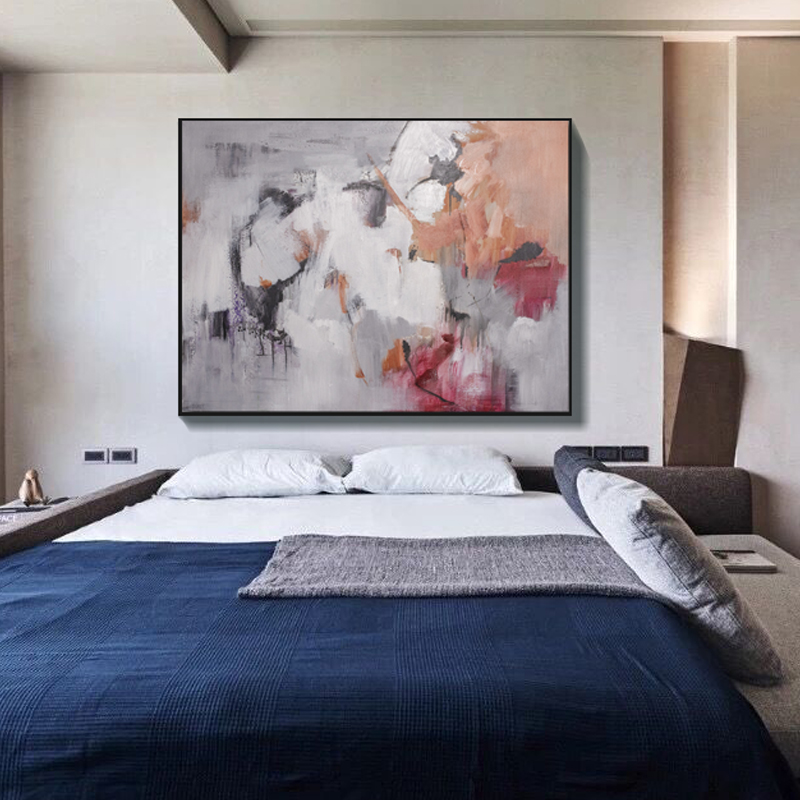
Correct sizing dictates the visual harmony. You cannot guess dimensions. Procurement relies on mathematical placement rules. Objective formulas ensure consistency. You can scale these formulas across hundreds of rooms easily.
Space-specific sizing strategies adapt these rules practically. Guest rooms require standardized approaches. We often specify triptychs above the bed. Three smaller panels fill wide spaces easily. Alternatively, use a single mid-sized panel. Ensure it adheres to the 2/3 rule carefully.
Lobbies and hallways demand bolder moves. You have high ceilings. You have long corridors. A towering large abstract painting acts as a wayfinding anchor. Place it at the end of a corridor. It draws the eye naturally. It helps guests navigate. In lobbies, massive art pieces dictate the room scale. Small pieces get lost on large lobby walls. Oversized canvases command immediate attention.
Sourcing art requires rigorous vendor evaluation. You must test their capabilities thoroughly. Never skip the prototyping phase.
The sample room phase is crucial. Always insist on physical prototypes. Never approve a bulk run based on PDFs. Digital screens distort colors significantly. A physical model room reveals the truth. Hang the prototype in the actual space. Evaluate color rendering under specific hotel lighting. LED bulbs change how paint looks. Warm 3000K bulbs differ from cool 4000K bulbs. Natural light shifts colors throughout the day. Check the artwork under all lighting conditions.
Assessing bulk capabilities prevents fulfillment disasters. A vendor might create one perfect prototype. Can they produce five hundred identical pieces? Verify their capacity to maintain color fidelity. Unit 1 must match unit 500 exactly.
Review their packaging protocols closely. Freight shipping destroys fragile artwork easily. Corners get crushed during transit. Canvases suffer punctures from loose hardware. Ask how the vendor prevents damage. They must use reinforced corner protectors. They should employ rigid outer boxes. On-site staging also presents risks. Sturdy packaging protects art while it waits for installation.
Always conduct an SLA and warranty review. Read the fine print carefully. Commercial lifecycles demand true longevity. Buyers should look for strong vendor guarantees. Ensure protection against UV fading. Demand warranties covering frame warping. The minimum acceptable commercial lifecycle is three to five years. Reputable vendors stand behind their materials.
Finalizing your package requires a systematic approach. Follow these precise procurement steps. They eliminate confusion. They prevent costly project delays.
Sourcing artwork involves deep strategic thinking. You must balance your aesthetic vision carefully. You must execute rigorous risk management. Beautiful designs fail without solid engineering.
Paying a premium makes excellent sense. Commercial-grade materials require higher initial investments. Structural integrity requires proper funding. However, this premium prevents massive hidden costs. Early replacements ruin budgets quickly. Maintenance failures damage property reputations. Do not cut corners on foundational quality.
Take immediate action on your next project. Request physical material swatches today. Ask your vendors for frame cross-sections. Order a single prototype first. Validate the quality thoroughly. Secure these tangible proofs before committing to any bulk contract.
A: Standard lead times range from four to eight weeks. Digital prints usually fulfill faster, hovering around the four-week mark. Hand-painted canvases require longer drying times, pushing fulfillment closer to eight weeks. Freight logistics and customs clearance can also add significant time. Always buffer your schedule accordingly.
A: It depends on local municipal fire codes. Commercial-grade art typically requires specific fire-retardant certifications. Public corridors and enclosed egress routes face strict regulations. Private guest rooms sometimes have softer requirements. You must verify local compliance laws before placing any bulk orders.
A: Vendors must apply clear-coat sealants over the artwork. These protective layers block moisture penetration. They allow housekeeping staff to use damp cloths for rapid dusting. The sealant prevents chemical degradation and stops color bleed. Never use abrasive cleaners on canvas surfaces.
A: Yes, custom oils are viable if managed correctly. Properly varnished oils withstand ambient conditions well. However, they remain physically delicate. You must place them out of direct physical reach. Keep them away from direct HVAC airflows to prevent rapid temperature fluctuations.